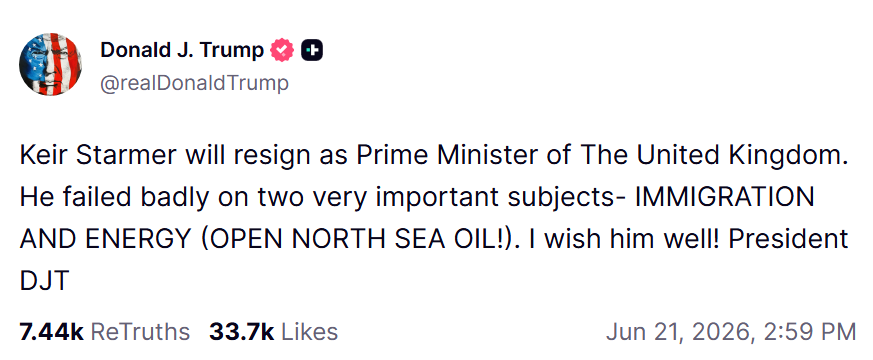
Donald Trump has claimed that Sir Keir Starmer will resign as Prime Minister, using a post on Truth Social to criticise the Labour leader over immigration and energy.
The US president said Starmer would step down from office and argued that he had “failed badly” on two major issues: immigration and energy. Trump also specifically referenced North Sea oil, calling for it to be opened up.
The intervention comes at a highly sensitive moment for British politics. Starmer is already under growing pressure inside Labour following Andy Burnham’s victory in the Makerfield by-election, a result that returned the Greater Manchester Mayor to Westminster and immediately strengthened speculation over a possible leadership challenge.
Trump’s post does not itself confirm that Starmer has resigned. The decision remains a matter for Starmer, the Labour Party and the British political system. However, the fact that a sitting US president has publicly commented on the future of the UK Prime Minister adds a remarkable international dimension to the leadership crisis.
Why Trump’s Comment Matters
Foreign leaders do not usually make direct public predictions about whether a British Prime Minister is about to leave office. Trump’s message was blunt, political and highly personal, linking Starmer’s difficulties to two of the most contested issues in Britain: immigration and energy policy.
Both subjects have become increasingly difficult for Labour. Immigration remains one of the biggest areas of public concern, while energy policy has become politically charged due to debates over bills, net zero, North Sea oil and gas, industrial jobs and energy security.
By mentioning North Sea oil, Trump also placed himself directly into one of Britain’s most divisive policy arguments. Supporters of continued oil and gas production argue that it protects jobs, strengthens energy independence and keeps investment in the UK. Critics argue that Britain should move faster away from fossil fuels and towards cleaner energy.
Burnham’s Return Raises the Stakes
Starmer’s immediate political problem is not Trump. It is Andy Burnham.
Burnham’s victory in Makerfield gave him a route back into Parliament and placed him in position to become a serious leadership contender if Labour MPs decide the party needs a change. His supporters believe he has a stronger connection with voters outside London and could help Labour respond to the rise of Reform UK.
That is why Trump’s comment landed so heavily. It arrived at a moment when questions about Starmer’s future were already dominating Westminster. Rather than creating the crisis, Trump amplified it.
For Starmer, the challenge is now twofold. He must convince Labour MPs that he can still lead the party, while also showing the public that his government has answers on the issues now being used against him: immigration, energy, living standards and trust in leadership.
An Unusual Political Moment
There is still no formal confirmation that Starmer has resigned. Until there is an official announcement from Downing Street, the Labour Party or Starmer himself, Trump’s post should be treated as a claim rather than a completed political event.
But the message has still changed the atmosphere. It has turned a domestic Labour leadership crisis into an international news story and placed Starmer’s future under even greater public scrutiny.
For Britain, the question is no longer only whether Starmer can survive a difficult week. It is whether his authority has already been damaged beyond repair.